What’s In This Guide
- What Are Solar Roof Shingles, and How Are They Different From Traditional Solar Panels?
- Which Solar Shingle Products Are Currently Worth Comparing?
- What Performance Specs Actually Matter When Evaluating the Best Solar Shingles?
- Does Your Home Actually Qualify for Solar Shingles?
- How Do You Choose a Solar Shingle Installer You Can Actually Trust?
- What Should Homeowners Expect After a Solar Shingle Installation?
- Are Solar Shingles a Practical Investment for Hudson Valley Homeowners?
- Frequently Asked Questions (FAQs)
- Ready to Find Out if Your Home Qualifies for Solar Shingles in the Hudson Valley?
Solar shingles have moved well past the concept stage. Homeowners across the Hudson Valley are comparing products, requesting quotes, and trying to determine which system actually delivers on its promises. The market is crowded, the specs are technical, and the price tags are high enough that a wrong choice carries real financial consequences.
Quick Facts
- The best solar shingles convert 14%–22% of sunlight into usable electricity.
- GAF Timberline Solar is the only product with a unified roof and power warranty.
- Well-specified systems retain at least 87.5% output capacity over 25 years.
- Manufacturer certification, not general solar licensing, determines warranty eligibility.
- Poughkeepsie averages 4.0 peak sun hours per day, enough to make solar shingles a viable investment.
What Are Solar Roof Shingles, and How Are They Different From Traditional Solar Panels?
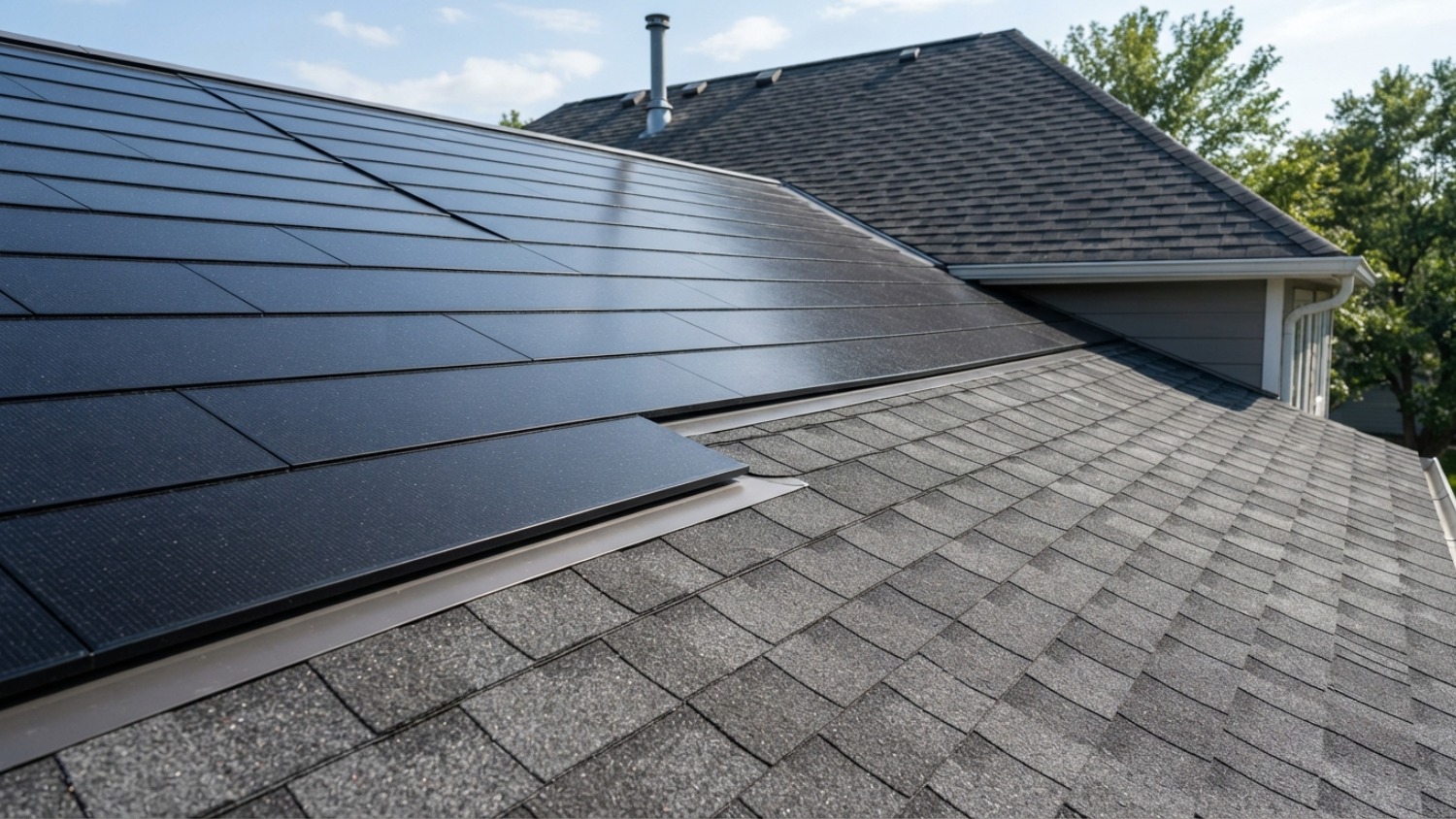
Solar roof shingles are a building-integrated photovoltaic (BIPV) product. They replace conventional roofing material while simultaneously generating electricity, eliminating the rack-mounting hardware that standard panels require. The core trade-off is aesthetics and integration against cost per watt.
|
Feature |
Solar Shingles |
Traditional Solar Panels |
|
Aesthetics |
Flush, low-profile, matches roofline |
Rack-mounted, visible above roof surface |
|
Efficiency Range |
14%–22% |
20%–23% (premium monocrystalline) |
|
Installation Method |
Nailed like standard shingles |
Mounted over existing roof |
|
Average Lifespan |
25–30 years |
25–30 years |
|
Roof Replacement Required |
Varies by product |
Not required |
|
Cost per Watt |
Higher |
Lower |
|
Best For |
Roof replacement and solar combined |
Structurally sound existing roof |
The best solar roof shingles make the most financial sense when a roof replacement is already part of the plan. Installing roofing solar shingles on a structurally sound roof that still has serviceable years left adds unnecessary cost to the project.
Which Solar Shingle Products Are Currently Worth Comparing?
Four products lead the residential market across the Northeast. Each targets a distinct buyer profile based on installation method, warranty structure, and regional availability.
|
Product |
Efficiency |
Product Warranty |
Power Warranty |
Retrofit Compatible |
Notes |
|
GAF Timberline Solar |
~22% |
25 years |
25 years |
No |
Single-point warranty; GAF Energy certified installers only |
|
Tesla Solar Roof |
~22% |
25 years |
25 years |
No |
Requires full tear-off regardless of existing roof condition |
|
CertainTeed Apollo II |
~18%–19% |
10 years |
25 years |
Yes |
Solid Northeast availability |
|
Suntegra Shingle |
~15%–17% |
10 years |
25 years |
Yes |
Limited Northeast availability |
Two distinctions stand out before narrowing the list:
Tesla Solar Roof mandates a full roof replacement regardless of how much life the existing roof has remaining. Homeowners absorb that cost whether the roof needs replacing or not.
GAF Timberline Solar is designed to install using a nailing method similar to traditional asphalt shingles and offers a unified warranty structure covering both the roofing system and power production. For many homeowners, this can simplify the warranty claims process compared to systems with separate roofing and solar warranties.
What Performance Specs Actually Matter When Evaluating the Best Solar Shingles?
Rated capacity at installation does not reliably predict long-term output. According to the National Renewable Energy Laboratory, these five metrics most directly influence real-world production across a system's full warranty term:
- Efficiency percentage: The share of sunlight converted to usable electricity. Higher efficiency matters most on smaller roof areas where the total active shingle count is limited by the layout.
- Wattage per shingle: Individual output ranges from approximately 45W to 70W. Total system wattage depends on how many active shingles the roof design can accommodate.
- Temperature coefficient: Measures how much output decreases as temperature rises. Products with a low temperature coefficient perform better in cold-climate regions like the Hudson Valley because solar cells produce more efficiently in cold, clear conditions than in heat.
- Annual degradation rate: NREL research shows that many PV systems degrade at approximately 0.5% to 0.7% per year. Over a 25-year warranty term, a properly specified system should retain at least 87.5% of its original rated capacity.
- Product warranty vs. power output warranty: These are two separate documents with two separate purposes. A product warranty covers manufacturing defects. A power output warranty guarantees the system will produce at a stated percentage of rated capacity for a defined number of years.
MORE ON THIS TOPIC: How Much Do Solar Shingles Cost?
Does Your Home Actually Qualify for Solar Shingles?
Not every roof is a viable candidate for roofing solar shingles. A professional site assessment is the only accurate qualification method. While online solar calculators and satellite-based estimates can provide a starting point, they cannot fully evaluate structural condition, localized shading, roof integrity, or framing load capacity.
Roof qualification checklist:
- Roof pitch: Solar shingles perform best on slopes between 2/12 and 12/12. Pitches outside that range limit product and installation options.
- Orientation: South-facing and southwest-facing roofs receive optimal solar exposure. East-west orientations are workable with appropriate system sizing adjustments.
- Shading: Partial shading from trees, dormers, or adjacent structures measurably reduces output. Full shade is disqualifying.
- Roof deck condition: Solar shingles are a 25-year commitment. A compromised deck or damaged framing must be corrected before installation begins, not after.
- Structural load capacity: Solar shingles may affect roof loading requirements depending on the product selected and the condition of the existing structure. A professional assessment should confirm compliance with local building code requirements before installation.
How Do You Choose a Solar Shingle Installer You Can Actually Trust?
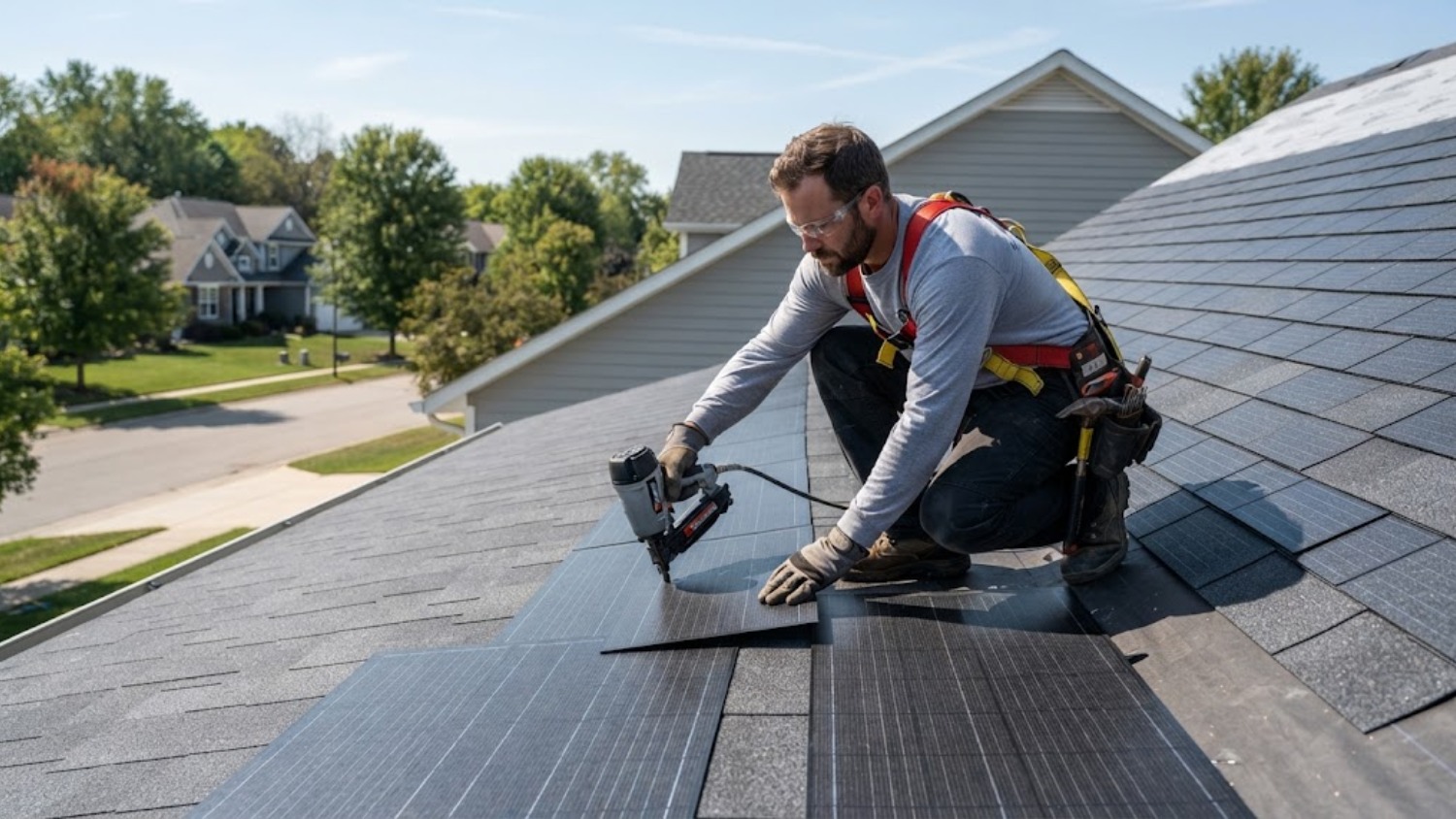
Step 1: Confirm Manufacturer Certification Before Anything Else
General solar licensing and manufacturer-specific certification are not the same credentials. GAF Energy-certified contractors carry separate requirements from standard GAF Master Elite roofing contractors. That distinction determines warranty eligibility and establishes who bears responsibility when installation-related issues surface.
Step 2: Review All Three Warranty Documents
Three separate warranties govern a solar shingle installation: the product warranty, the power output warranty, and the workmanship warranty. The workmanship warranty is issued by the installer, and its terms vary by contractor. Request all three documents in writing before signing.
Step 3: Confirm Permitting and Utility Interconnection Timelines
New York State permitting covers structural, electrical, and zoning review. Utility interconnection is a separate approval process that enables two-way power flow between the solar system and the grid. Depending on the utility, that approval can take 30 to 90 days. Factor it into project scheduling before committing to an installation date.
Step 4: Request a Site-Specific Production Analysis
A credible production estimate uses actual roof orientation data, modeled shading losses, and local solar resource inputs. The Hudson Valley averages approximately 4.0 to 4.5 peak sun hours per day, according to NREL solar resource mapping. Any contractor quoting without that data is working from assumptions rather than measurements.
Step 5: Compare Quotes on Price per Watt, Not Total Price
Total price comparisons are misleading when system sizes differ. Price per watt is the standardized comparison metric across solar installations. A lower total project cost for a smaller, underperforming system is not a better deal when output requirements are not met.
Red flags to watch for in any quote:
- No shading or production analysis included
- Warranty language that does not specify which coverage applies to which system component
- Pressure to sign before the interconnection approval timeline is clearly explained
What Should Homeowners Expect After a Solar Shingle Installation?
Installation day is not the finish line. Understanding what comes after helps homeowners protect their investment and catch output issues before they compound.
Production Monitoring
Most solar shingle systems include inverter-based monitoring accessible through a manufacturer’s app or web portal. Homeowners should review monthly production data against the baseline established in the pre-installation production analysis. A consistent gap between projected and actual output warrants a service call, not a wait-and-see approach.
Routine Roof Inspections
Solar roof shingles do not require specialized cleaning or maintenance beyond what a standard roof inspection covers. Annual or biennial inspections from a certified roofing contractor confirm that shingles, flashing, and the underlying deck remain in warranty-compliant condition.
Warranty Documentation
Keep all three warranty documents, product, power output, and workmanship, in a single file alongside the permit records and interconnection approval. These documents are essential if output drops below the warranted threshold or if ownership transfers at resale.
Utility Billing After Interconnection
Once the system is active and net metering is in place, monthly utility bills shift from a gross consumption charge to a net usage calculation. Some homeowners are surprised to receive a utility bill even after their solar system begins generating electricity. Utility charges are typically based on net electricity usage after accounting for solar production and any credits earned through net metering.
Year-Over-Year Tracking
Comparing annual production data against the baseline year gives homeowners the clearest picture of system health. Any single-year output drop greater than 5% that weather or shading cannot account for warrants a professional assessment before the production warranty is invoked.
Are Solar Shingles a Practical Investment for Hudson Valley Homeowners?
For homeowners already planning a roof replacement, the financial case is meaningfully stronger than for those replacing a sound roof solely to add solar generation. Current incentive and billing programs may help improve the financial case:
- NY-Sun Incentive Program: A NYSERDA-administered incentive available to eligible homeowners across Dutchess, Orange, Putnam, and Ulster Counties.
- New York net metering: State law requires utilities to credit homeowners for excess power returned to the grid. Both Central Hudson and Con Edison service territories across the Hudson Valley participate in the program.
- Snow load performance: Poughkeepsie averages approximately 36 inches of annual snowfall, per Current Results climate data. Most solar shingles carry standard residential snow load ratings, and sloped installation angles support natural snow shedding.
- Cold-weather output: Because solar cells generally perform more efficiently in cooler temperatures than in extreme heat, Hudson Valley winters can support strong solar production when adequate sunlight is available.
Frequently Asked Questions (FAQs)
What happens if part of my roof is damaged after solar shingles are installed?
Localized damage can be repaired without replacing the entire system. Affected active shingles are removed, the deck is repaired, and replacement shingles are reinstalled. Because the repair touches both roofing and electrical components, it must be handled by a contractor certified in both disciplines.
Are solar shingles available in different colors or profiles to match my home’s exterior?
Current products offer a limited color range compared to conventional asphalt shingles. GAF Timberline Solar, for example, is available in Charcoal and Pewter Gray, designed to match the Timberline HDZ shingle line. Confirm visual compatibility with your installer before committing to a product.
Do I need HOA approval before installing solar shingles in New York?
New York State limits an HOA’s ability to prohibit solar outright, but associations can impose reasonable aesthetic restrictions. Submit a formal request before signing a contract, as approval timelines vary. New York’s solar access protections are outlined under Real Property Law Section 335-b.
Can a solar shingle system be expanded after the initial installation is complete?
Expansion is possible but complex. It requires a new permit, additional interconnection review, and likely an inverter reassessment. Homeowners expecting to add an EV charger or heat pump should size for that future load during the initial installation rather than planning to expand later.
How do solar shingles perform during extended cloudy or overcast periods?
Solar shingles generate power from diffuse light, so output continues during overcast conditions at a reduced rate. For a fixed tilt, non-tracking panel mount in Poughkeepsie, the average annual peak sun hours are 4.0 hours per day. Any credible production estimate for this region should reflect that variability, not peak-condition output alone.
Ready to Find Out if Your Home Qualifies for Solar Shingles in the Hudson Valley?
Lyndsey Roofing, LLC is a GAF Energy-certified contractor serving homeowners throughout the Hudson Valley. If you’re considering solar shingles, a professional site assessment can help determine whether your roof qualifies, estimate potential energy production, and identify the most suitable system for your home.
Founded by Bill Reilly with a mission built around protecting Hudson Valley homes, the company carries the credentials required to install and support GAF Energy solar shingle systems.